There won’t be any more posts on this blog. Time to move to other projects.
Thanks to all the people who have supported the blog during these 5 years.
* *
*
Reassessed aural delicacies
There won’t be any more posts on this blog. Time to move to other projects.
Thanks to all the people who have supported the blog during these 5 years.
* *
*


Including Walloon- and Flemish-based composers from the Brussels area (Bierges, Archennes, Leuven), this double LP set, the sole compilation to appear on Lawalrée’s Walrus Records, is also the most experimental release on the label. Dominique Lawalrée‘s own contribution, a static, elongated electric organ drone punctuated with pointillistic electronic ornaments, is more radical than other works I posted previously. The only work on this disc to make use of musique concrète sounds, extensive sound processing and studio treatment, Baudouin Oosterlynck‘s disturbing, S&M soundtrack Suite for a Bondage Room was included in the 4-CD box-set retrospective on Metaphon in 2008. The minimalist piano music of With Hidden Noise (after Marcel Duchamp) was recorded by Eric de Visscher when he was only 23-years old and is his first record release. A composer, music theorist and John Cage specialist, de Visscher became director of IRCAM in 1997 until 2003 when he became director of Musée de la Musique in Paris. Born in 1938, Robert Fesler may be the oldest composer on this compilation, yet his music sounds like contemporary electronica. Fesler was an electronic engineer who built his own synthesizer, in this case the “RPF 756”.
01 Dominique Lawalrée Still Life (18:55)
02 Baudouin Oosterlynck Suite for a Bondage Room (21:42)
03 Eric De Visscher With Hidden Noise (19:00)
04 Robert Fesler Tristesse (12:20)
05 Robert Fesler Le Temps des Poissons Touche à sa Fin (9:50)
Total time 1h 21mns
2xLP released by Walrus, ref. WLS 12 & 13, Brussels, Belgium, 1984
* *
*


Californian performer and audio artist Jackie Apple produced the Soundings radio show on KPFK-FM Los Angeles Public Radio from 1981-1995, where she aired experimental music and sound art and commissioned numerous new radio plays from US sound artists. Between 1983 and 1995, she was a contributing editor to the quarterly journal High Performance founded by Linda Frye Burnham in Los Angeles (1978-1997). One of Jacki Apple’s first release was the artist book Trunk Pieces, published in 1978 by Visual Studies Workshop Press, Rochester, a collection of found photographs used to create a semi-autobiographical narrative – a process similar to her use of archive recordings and found sounds in her audio works. Apple’s soundwork Black Holes/Blue Sky Dreams was included in the Airwaves compilation LP on One Ten Records in 1977 along Meredith Monk, Laurie Anderson and Terry Fox, a.o. Jacki Apple is professor at Pasadena College of Design since 1983.
♫ The Mexican Tapes was Jacki Apple’s first full-length disc release. It was published in 1980 by One Ten Records – who put out Laurie Anderson’s O Superman single in 1981. The soundtrack to a Super 8 color film, The Mexican Tapes is a complex combination of archive recordings, fictionnal investigation and spoken word interwoven into a multi-layered narrative. It is actually a polyphony of male and female voices reading simultaneously from a variety of sources including Mayan and Aztec sacred texts, diplomatic and CIA papers, US presidents speeches, Cold War propaganda, excerpts from Octavio Paz or Roland Barthes books, Trotsky’s stay in Mexico, the 1968 Mexico Olympics, etc. At times, there’s an exquisite underlying ambient music soundtrack made of small percussion, whistling, flute and sound effects, an allusion to Ancient Mayan music in the way Jorge Reyes did, just much more minimal. But I must confess I struggle to grasp the meaning of this collage or to reconstitute a coherent narrative in The Mexican Tapes.
01 The Mexican Tapes (24:54)
02 The Mexican Tapes – continued (26:20)
Total time 51:14
LP released by One Ten Records, ref. 003, New York, N.Y., USA, 1980
* *
*


Inspired by Jon Rose’s first Relative Band Festival held in Sydney in 1984 – where Ross Bolleter, Tos Mahoney, Mark Cain and Richard Ratajczak all performed–, the first Perth Festival of Improvised Music took place in April 1985 at Praxis Gallery in Fremantle, Western Australia, and was directed by flautist Tos Mahoney, half of the Fremantle-based Alone Together duo with Ross Bolletter, whose first cassette also appeared in 1985. The musicians performing during the 1st Perth Festival formed the nucleus of free music improvisation in Western Australia during the 1980s and, to a large extend, still do today. The festival also included performances by saxophonist Steve Moore and singer Gillian McGregor, both visiting musicians from Great Britain. There was a 2nd edition of the Perth festival in 1986.
♫ Instead of documenting the festival’s proceedings in chronological, successive solos, duets, trio, etc, producer Robbie Muir chose to create a continuous mix from the individual tracks he recorded. He completely succeeded in recreating a collective performance incorporating music theatre, invented instruments and contemporary music elements. The musicians themselves favor abstract sound textures, long held notes and extended techniques, which all melt effortlessly in Muir’s mix. Ross Bolleter is well-known today for his ruined piano outdoor performances, but at the times he was merely using inside-the-piano techniques in his music.
01 Perth Festival of Improvised Music (24:14)
02 Perth Festival of Improvised Music – continued (23:58)
Ross Bolleter, piano, piano accordion
Mark Cain, woodwind, didgeridoo
Gillian McGregor, vocals
Tos Mahoney, flute
Steve Moore, soprano saxophone
Richard Ratajczak, double bass
The P.F.I.M. Ensemble = all the above
Total time 48:12
LP released by Impro Records, Perth(?), Australia, 1985
Download or download (alternate link)
* *
*


Apparently his 5th LP, Dominique Lawalrée‘s “Vis à Vis”, or Face to Face, published in 1979, is entirely played on a Bösendorfer grand piano, but instead of the brick and mortar barrage of fortissimos this kind of instrument is prone to (think Cecil Taylor, for instance), here it is used to enunciate semi-detached, tentative piano chords and to explore different shades of silence, so to speak. In this respect, Vis à Vis is very close to Spanish composer Federico Mompou‘s piano cycle Musica Callada, or Silent Music (1959-67), itself a cornerstone of European minimalist music. Vis à Vis is a kind of update of Musica Callada, incorporating Lawalrée’s typical Belgian saudade and sublimely nostalgic mood. This music suits rainy days well, I find.
01 Bonjour Chez Vous ! (2:00)
02 Listen To The Quiet Voice (3:58)
03 Lost In Useless Territory (1:18)
04 Remember Those Quiet Evenings (7:04)
05 Personnages (2:55)
06 Morton A Fait Peur A Karlheinz (8:32)
07 Poissons Rouges, La Nuit… (12:51)
Total time 38:40
LP released by Walrus, ref. WLS 006, Brussels, Belgium, 1979
* *
*


French composer Lucien Bertolina, born 1946, was first an improvisor and trombone player before becoming one of the leading figures in electroacoustic music in the South of France when he co-founded the Marseilles electroacoustic music studio, or Groupe de Musique Expérimentale de Marseille, in 1969 with Jacques Diennet, George Boeuf and Michel Redolfi. Other musicians working at the studio have included Patrick Portella and Raphaël de Vivo. Also a film music composer, radiophonic artist and field recordist, Bertolina created an independent local radio in Marseilles named Radio Grenouille with a special focus on radiophonic art and field recordings.
♫ First composed in 1982 for trombone and tape, Aller Simple was transcribed for cello and tape in 1985. The tape part consists of processed synthesizer, musique concrete sounds and found sounds including some conversation and train recordings. The music is a gorgeous, poetical travelogue retaining its mystery and impenetrability throughout the piece. In Aller Simple, the acoustic instrument runs parallel to the tape and doesn’t interfere or take the lead, while Vorticosamente is more like a cello+electronics dialogue where tape parts underline the acoustic instrument or function as a counterpoint. Some of the tape music consists in pre-recorded cello parts.
01 Aller Simple (17:45)
02 Vorticosamente (15:40)
Norbert Bordetti, cello
Lucien Bertolina, electronics and tape
Total time 33:25
LP released by GMEM, ref. AL02, France, 1985
* *
*
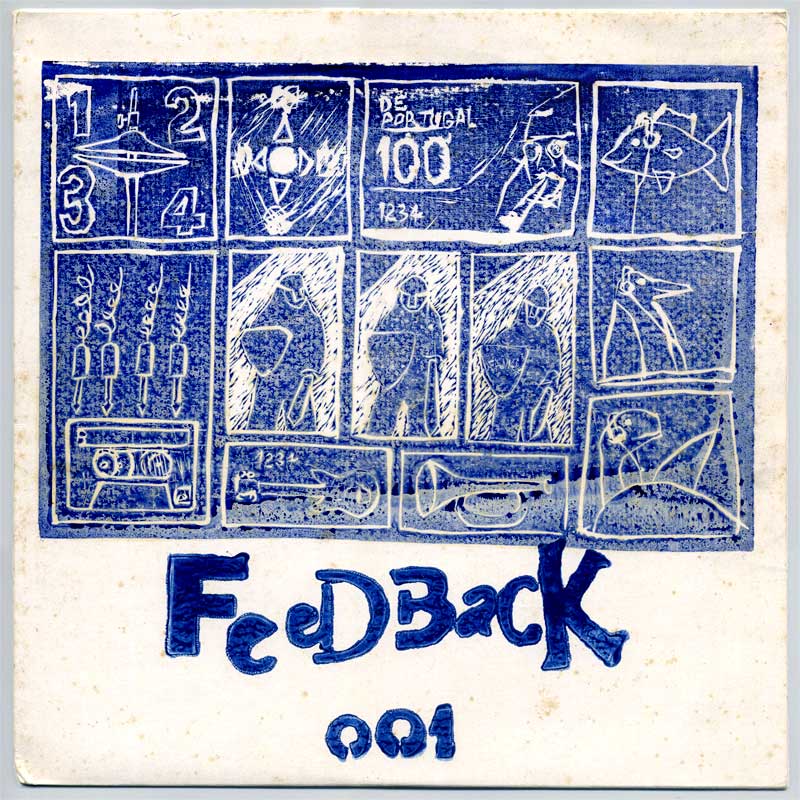
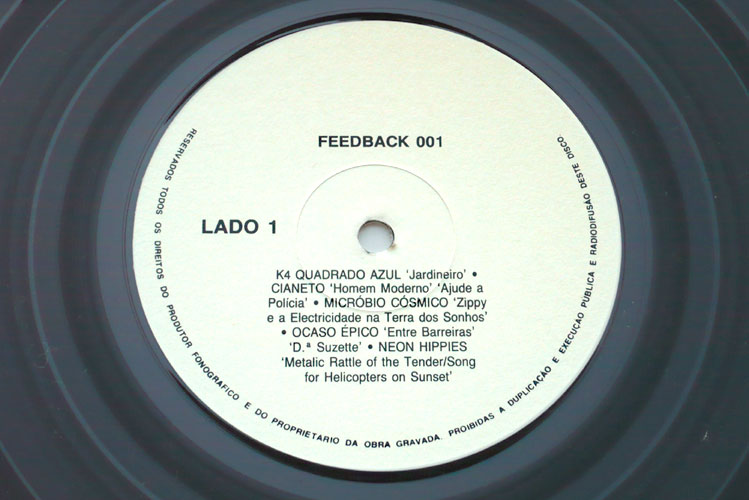
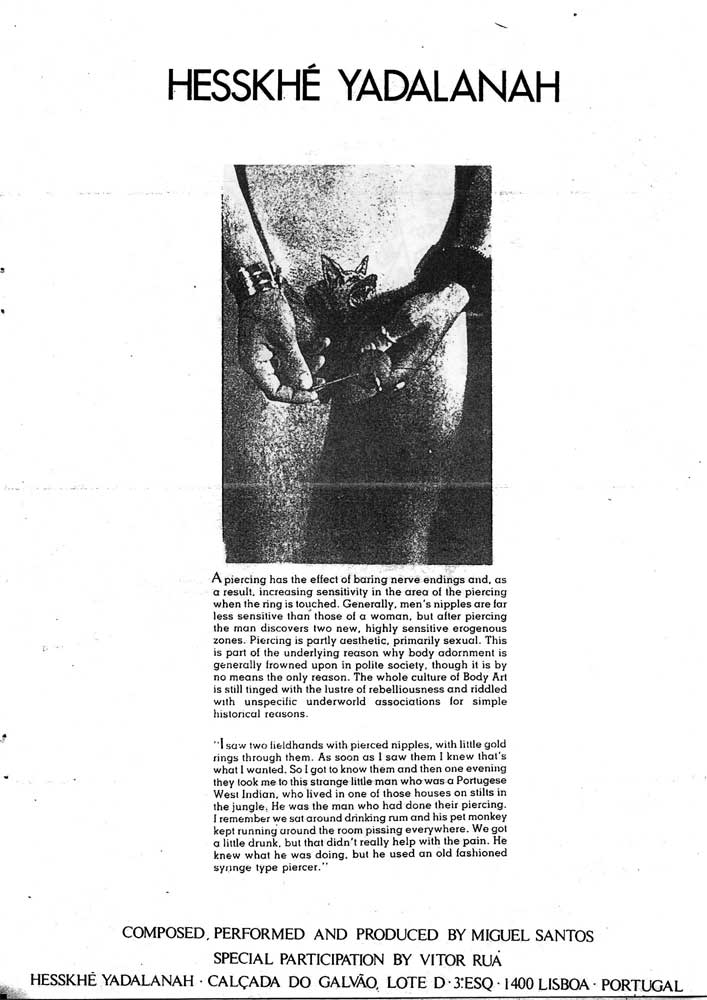
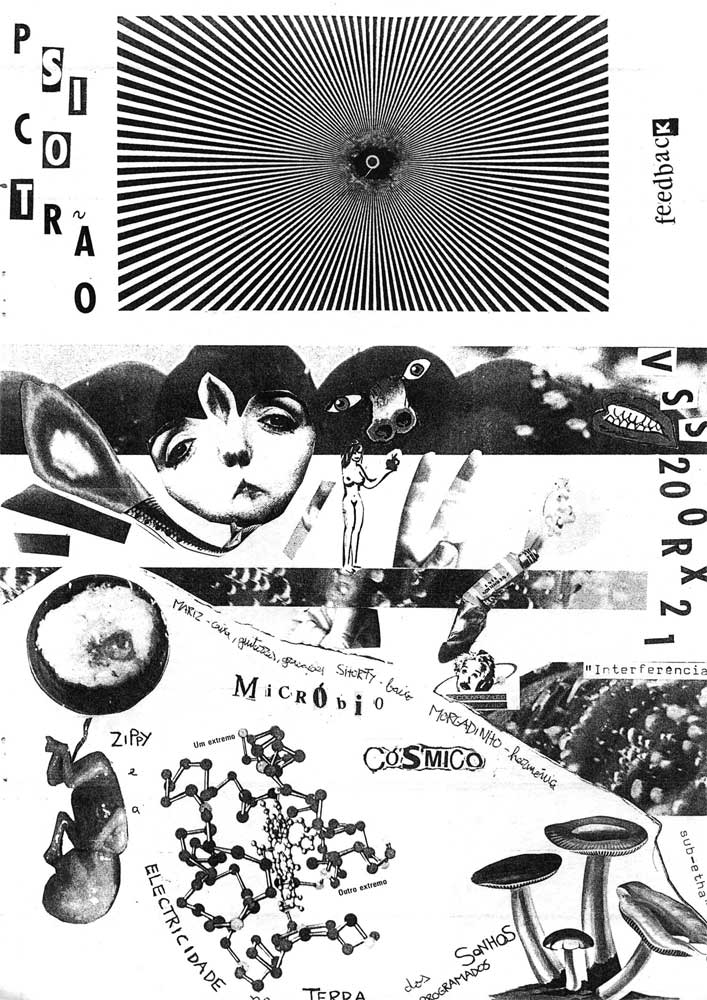
Published in 1990, the Feedback #001 anthology blends post-punk and anarcho-punk bands like K4 Quadrado Azul, C.I.A. neto or Censurados, avant-rock acts like Ocaso Épico or Neon Hippies with experimental tracks by the likes of Microbio Cosmico, Hesskhé Yadalanah, VSS200 RX21, or Psicotrão. These bands were part of a burst of creativity in the Portuguese independent music scene circa 1988-91, when Telectu were at the peak of their international career, and with the releases of Nuno Canavarro’s Plux Quba (1988), Nuno Rebelo’s Sagração Do Mês De Maio (1989), Osso Exótico’s debut LP (1990), Vítor Rua’s Vidya compilation LP (1991) or Miguel Santos’ legendary Johnny Blue compilations in 1991, to name but a few major acts in the field of experimental music. Apparently, at that time, Portuguese record labels weren’t strictly genre-bound – i.e. punk band Censurados’s 1st LP was scheduled on Ama Romanta, the label which had just released the Nuno Canavarro LP – the disc eventually appeared on El Armadillo. This kind of open-mindedness is palpable on Feedback #001, with, for intance, Ocaso Épico’s tape loops+spoken words on #5 and rock song ala Reynaldo and the Loaf on #6, or the bass-driven post rock ala Rothko/Tortoise of Neon Hippies. Feedback #001 celebrates a certain Portuguese D.I.Y. and Anarchist ethos ca.1990 with a hand-made cover artwork, a zine-like, xeroxed booklet and the absence of a record label – indeed, the rarity of this disc testifies to the limited circulation and distribution it had at the time of its release.
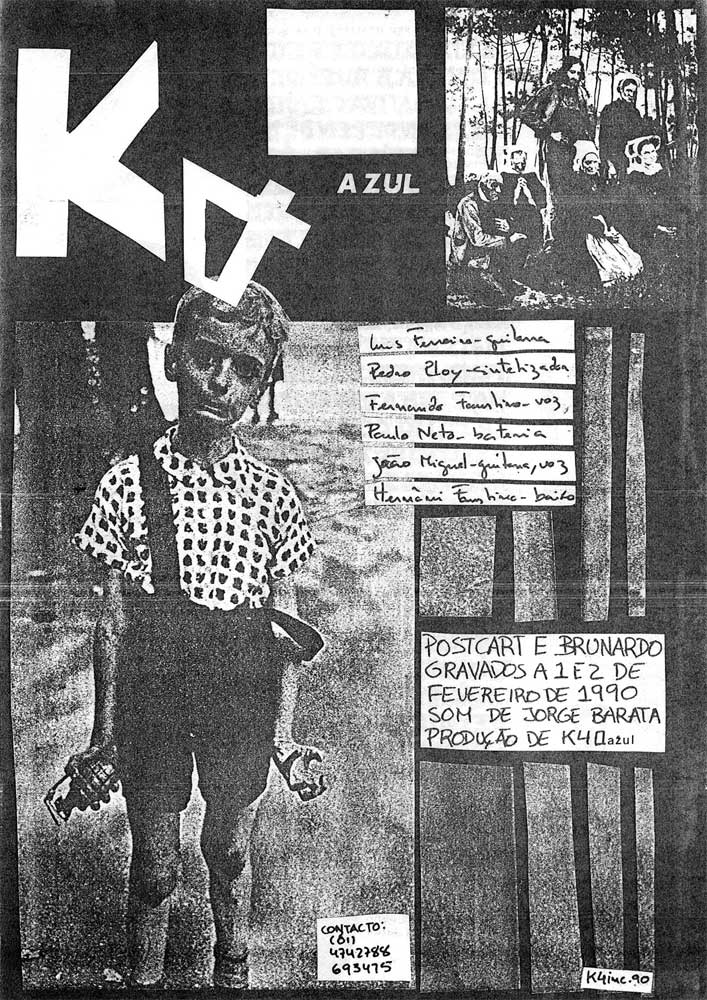
01 K4 Quadrado Azul – Jardineiro (4:45)
02 C.I.A. neto – Homem Moderno (1:46)
03 C.I.A. neto – Ajude a Policia (1:38)
04 Microbio Cosmico – Zippy e a Electricidade na Terra dos Sonhos programados (4:03)
05 Ocaso Épico – Entre Barreiras (1:33)
06 Ocaso Épico – D. Suzette (3:36)
07 Neon Hippies – Metalic Rattle of the Tender
+ Song for Helicopteres on Sunset (3:32)
08 The New Hard Noise Heavy Rock Cyber Speed
Sonic Metal Punk Acid Sound – s/t (2:27)
09 Censurados – Senhores Politicos (3:41)
10 Censurados – Não Vale Nada (2:50)
11 K4 Quadrado Azul – Tudo é Meu (3:14)
12 Hesskhé Yadalanah – Leukôstomé (4:48)
13 VSS200 RX21 – Interferências em Sub-Etha (2:39)
14 Psicotrão – Feedback (2:22)
Total time 42:50
Self-released LP, Portugal, 1990
. . . . . . . .
* *
*


Collecting tracks recorded between 1979 and 1981, Dominique Lawalrée‘s achingly melancholic Clandestin LP, published in 1982, belongs to his more “experimental” period, before he turned to solo piano and church organ – on Lawalrée, see previous post.
♫ In Clandestin, the composer explores the possibilities of various keyboards to channel his deeply nostalgic melodies, including the Wurlitzer and Hohner electric pianos, or the Yamaha CS80 and Roland String synthesizers. The music combines minimal piano playing with these electronic instruments to conjure images of an urban nostalgia infused with the personal feelings and reminiscences of a sorrowful mind. Yet each track is also complemented with either field recordings (the church carillon at end of tr.#1, the street recording on #5), spoken word (the interview on #3 and the poetry reading on #5), or found sounds (the radio report on the death of John Lennon in 1980 on #6). In tr.#5 Millénaire, it takes 5 mins to Lawalrée to muster the words “Bruxelles a eu 1000 ans cet été” (or, Brussels turned 1,000 years old last summer), as the sentence is broken into multiple parts and constantly interrupted by tentative electric piano chords.
One last thing: if you look at the front and back cover images, you’ll realize the composer is sitting almost at the same place as the little girl in the painting, as if he had paused, surrounded by autumn leaves, to listen to the absent music of some vanished musicians. I can’t think of a better metaphor to describe Lawalrée’s “musique en creux” on this extraordinary disc.
01 Rainy Sunday: Dimanche Pluvieux (6:28)
02 Le Secret Blanc (14:28)
03 La Maison Des 5 Éléments (9:34)
04 Please Do Not Disturb (2:10)
05 Millénaire (5:05)
06 Now Peace For Beatle John (2:04)
Total time 40:00
LP released by Walrus, ref. WLS 011, Brussels, Belgium, 1982
Download [new link]
* *
*

 Continuo's weblog